

Cart
1

Table of Contents
- How Orthopedic Beds Support Joints and Pressure Points
- Why Senior Dogs Benefit Most From an Orthopedic Dog Bed for Senior Dogs
- How an Orthopedic Dog Bed for Arthritis Relieves Stiffness
- Orthopedic vs. Memory Foam Dog Bed: What's the Difference?
- How to Choose an Orthopedic Dog Bed for Your Dog
- Caring for Your Orthopedic Bed: Cleaning and Foam Longevity
- Orthopedic Beds Beyond Joint Pain: Recovery, Sleep, and Daily Comfort
- Frequently Asked Questions
Last Updated: October 4, 2026
How Orthopedic Beds Support Joints and Pressure Points
An orthopedic dog bed is a bed built with dense support foam that holds a dog's body evenly instead of letting it sink into soft filling. The benefits of orthopedic beds for dogs start with one simple idea: a supportive surface spreads body weight across the whole frame rather than concentrating it on hips, elbows, and shoulders. At Paws ND Whiskers, we hear from owners every week who watched their dog struggle to get comfortable on a standard bed, and the difference a firmer surface makes is often the first change they notice.
Weight Distribution and Body Contouring
High-density orthopedic foam compresses under the heaviest points and stays put under the lightest ones. That's body contouring in practice: the foam molds to a dog's shape so weight distribution stays even. Pressure points stop taking the full load. For a dog that sleeps eight to twelve hours a day, that matters more than most owners expect.
Spinal Alignment and Firm Support
Firm support keeps the spine level instead of letting it curve into a sagging dip. A bed that's too soft lets the middle of the body drop, which puts strain on the lower back and hips. Orthopedic foam holds its shape, so the dog rests in a neutral position. That's the quiet benefit owners report most often: a dog that wakes up without stiffness.
Why Senior Dogs Benefit Most From an Orthopedic Dog Bed for Senior Dogs
Aging changes the surface a dog sleeps on in three measurable ways. Muscle mass around the spine and hindquarters declines, so there is less natural padding between bone and floor. The cartilage that cushions joints thins, which lowers the threshold at which pressure becomes painful. And total sleep time increases, meaning a senior dog may spend 14 to 16 hours a day in contact with its bed. An orthopedic dog bed for senior dogs addresses all three at once by replacing the floor's hard, unyielding surface with foam that distributes load across a wider area.
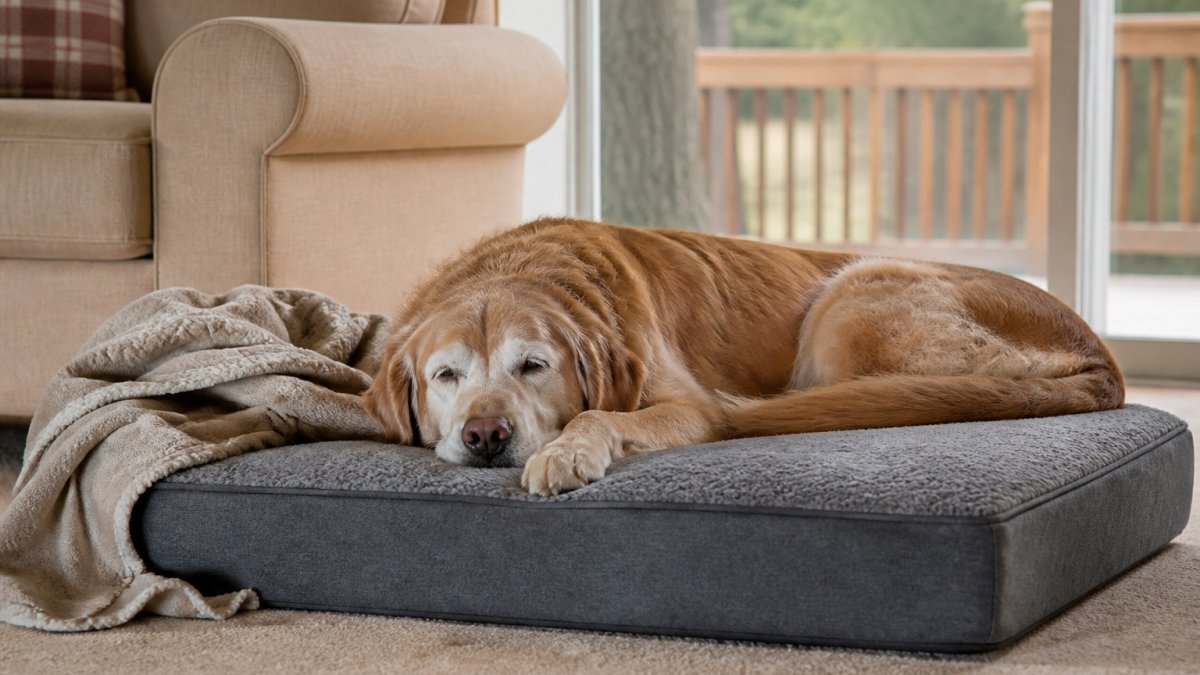
What the support actually does
High-density foam does not "cushion" joints in the way a pillow cushions a head. It limits how far the body sinks, which keeps the hips, elbows, and shoulders from bottoming out against a hard surface. For a dog with reduced muscle cushioning, that difference is the mechanism behind the stiffness owners notice at wake-up. Most practitioners describe the effect as comfort support rather than treatment, the bed removes a source of pressure, but it does not slow joint disease.
Signs a senior dog has outgrown a standard bed
Watch for these patterns, ideally two or more together:
- Struggling to stand up after a nap, especially on smooth floors
- Circling repeatedly or pawing before lying down
- Shifting position several times through the night
- Avoiding hard floors but still seeming uncomfortable on the old bed
- Reluctance on stairs or when jumping into the car after rest
If two or more sound familiar, the bed is usually the least expensive variable to change first.
Age stage and body size change the answer
A 12-pound terrier and a 90-pound Labrador do not need the same bed. Lighter seniors often do fine with a 2- to 3-inch foam layer, while dogs over roughly 50 pounds generally need 4 inches or more of high-density foam to avoid bottoming out. Giant breeds may need 5 to 6 inches. Dogs with hip dysplasia often do best on a low-profile bed with a step-down front so they can walk on rather than climb in.
Key Takeaway
A bed is a comfort tool, not a treatment. If your dog is limping, yelping, or losing mobility, see your veterinarian first. The bed supports the recovery plan; it does not replace it.
Introduce the new bed next to the old one for a few days. Dogs anchor comfort to location, and swapping both the bed and its spot at once makes the transition twice as hard.
How an Orthopedic Dog Bed for Arthritis Relieves Stiffness
An orthopedic dog bed for arthritis helps by reducing the pressure that builds up on inflamed joints during rest. Arthritis in dogs shows up as stiffness after sleeping, reluctance on stairs, and a slower walk. A supportive surface won't reverse joint disease, and no bed treats a medical condition. What it can do is remove one source of daily discomfort so the dog rests better and moves more easily when it gets up.
Orthopedic vs. Memory Foam Dog Bed: What's the Difference?
The two terms get used interchangeably, and that's the problem. Orthopedic describes the job: firm, supportive foam that holds a dog's frame. Memory foam describes a material: heat- and pressure-sensitive foam that softens and molds to the body. Some orthopedic beds use memory foam. Some use high-density foam instead. Some use both, with a firmer base and a memory foam top layer.
The numbers that actually matter
When you shop, the useful specifications are density and firmness, not the marketing label.
- Density is measured in pounds per cubic foot (lb/ft³). Higher density means more foam material per volume and generally longer life. Beds marketed as orthopedic typically fall in the 1.8 to 3 lb/ft³ range; anything under about 1.5 lb/ft³ tends to flatten within months.
- Firmness is often expressed as ILD (indentation load deflection), the force needed to compress the foam 25 percent. Higher ILD means firmer. A firm base for a large dog commonly sits in the 50 to 70 ILD range, while a soft comfort top runs lower.
- Thickness matters more than most buyers expect. A 2-inch foam layer compresses to almost nothing under a 70-pound dog. Four inches or more is the practical minimum for medium and large seniors.
| Bed Type | Feel | Best For | Watch Out For |
|---|---|---|---|
| High-density orthopedic foam | Firm, holds shape | Large dogs, seniors, arthritis | Can feel too hard for light dogs |
| Memory foam | Softens and molds | Dogs that like to sink in | Traps heat; low-density versions sag |
| Orthopedic + memory foam top | Firm base, soft surface | Most senior dogs | Higher cost, thicker profile |
| Standard polyfill bed | Soft, flattens fast | Puppies, light chewers | Loses support within months |
The practical rule
Firmness supports joints; softness supports comfort. Most senior dogs do best with both, which is why layered beds, a dense base under a conforming top, have become the default recommendation. If you can press the bed flat with one hand, it is too soft for a large dog regardless of what the label says.
"Memory foam" alone is not a quality signal. A thin, low-density memory foam topper over polyfill will feel plush in the store and collapse within a season. Ask for the foam density or skip the bed.
How to Choose an Orthopedic Dog Bed for Your Dog
Start with the dog, not the bed. Size, firmness, and shape all follow from body weight, sleeping position, and health needs. A 90-pound Labrador and a 12-pound terrier need completely different foam densities, and a bed that's too small forces a dog to curl tightly, which defeats the purpose.
Size, Firmness, and Shape
- Size: Measure your dog nose to tail while stretched out, then add roughly 6 inches on each side.
- Firmness: Heavier dogs need denser foam. If you can press the bed flat with one hand, it's too soft for a large dog.
- Shape: Curlers do well with a bolster bed. Stretchers need a flat, open mattress. Dogs with hip dysplasia often prefer a low-profile bed they can walk onto.
Accessibility and Temperature
A thick bed with a high rim is hard for an arthritic dog to climb into. Look for a low entry edge or a bed with a step-down front. Temperature matters too: memory foam traps heat, which is welcome in a cold room and miserable in summer. A removable, breathable cover solves most of that problem.
Put the new bed where your dog already sleeps, not where you'd prefer it to go. Dogs anchor comfort to location, and moving the bed at the same time as changing it makes the transition twice as hard.
Caring for Your Orthopedic Bed: Cleaning and Foam Longevity
Foam is the part that wears out, and how you clean it decides how long the bed lasts. Most orthopedic beds have a removable cover you can machine wash, but the foam core itself should never go in a washer. Water breaks down foam cell structure, and a soaked core loses its support permanently.
A simple routine keeps a quality bed in service for years:
- Vacuum the cover weekly to lift hair and dander
- Wash the cover every two to four weeks in cold water, air dry
- Spot-clean the foam with a damp cloth and mild soap, then air dry fully
- Rotate or flip the foam every few months so it wears evenly
- Check for flattening by pressing the center; if it stays compressed, the foam is done
Watch Out
Never put the foam core in a dryer or leave it damp. Heat and trapped moisture both break down the foam, and a bed that smells of mildew will get avoided by your dog long before it loses support.
Orthopedic Beds Beyond Joint Pain: Recovery, Sleep, and Daily Comfort
Joint support is the headline, but it isn't the whole story. Dogs recovering from surgery, dogs with old injuries, and dogs that simply sleep on hard floors all benefit from the same supportive surface. Better sleep quality shows up in ways owners notice: a dog that's more alert in the morning, more willing to walk, and less stiff after a nap.
That's the honest case for orthopedic beds. They don't cure anything. They give a dog a better surface to rest on, and rest is when the body does its repair work. For a senior dog, that's not a small thing.
Paws ND Whiskers carries orthopedic beds built around high-density support foam, along with the cozy bedding and everyday essentials that keep a senior pet comfortable. If you're not sure which firmness suits your dog, our team is happy to talk through size, weight, and sleeping style before you buy. Add to Cart when you're ready, and give your dog the kind of rest that makes the next morning easier.
Frequently Asked Questions
Do orthopedic dog beds really help?
Yes, for many dogs. Orthopedic beds use high-density or memory foam to distribute weight evenly and reduce pressure on joints. However, results vary by dog, and a bed is not a medical treatment. It works best as part of a broader plan that may include veterinary care, weight management, and gentle exercise.
Is memory foam or orthopedic better for dogs?
It depends on your dog's needs. Orthopedic foam is typically firmer and provides stable skeletal alignment, which suits senior dogs or those with hip dysplasia. Memory foam contours to the body and relieves pressure points, making it a good fit for dogs with arthritis or post-surgery recovery. Some beds combine both. If your dog struggles to get up, a firmer orthopedic base with a memory foam top layer often works well.
Can an orthopedic dog bed help with arthritis?
An orthopedic dog bed can help manage arthritis discomfort by cushioning joints and reducing pressure on inflamed areas. The firm support keeps your dog's spine aligned and makes it easier to stand up. While it won't cure arthritis, many owners report their dogs move more easily and sleep better. Pair the bed with veterinary guidance, joint supplements, and low-impact exercise for the best results.
How do I choose the right orthopedic bed for my dog?
Start with your dog's size and sleeping style. Measure your dog from nose to tail and add a few inches so they can stretch out. For firmness, choose a firmer orthopedic foam for senior dogs or those with hip dysplasia, and a plusher memory foam for arthritis or pressure-point relief. Consider accessibility: a low-profile bed helps dogs with mobility issues. Also check the cover is machine washable and the foam holds its shape over time.

