

Cart
1

Table of Contents
- Quick Comparison: Best Calming Enrichment Toys 2026
- KONG Classic Dog Toy: The Gold Standard for Stuffable Calming
- Snuggle Puppy Behavioral Aid Toy: Heartbeat Comfort for Separation Anxiety
- Nina Ottosson by Outward Hound Puzzle Toy: Mental Gymnastics for Boredom Busting
- West Paw Zogoflex Qwizl: Best Durable Toys for Aggressive Chewers
- Forager Snuffle Mat: Scent Work for Natural Calming
- How to Choose Safe Enrichment Toys for Dogs
- How Long Should a Dog Play with Enrichment Toys?
- Frequently Asked Questions
Last Updated: October 2, 2026
Quick Comparison: Best Calming Enrichment Toys 2026
The best calming enrichment toys 2026 has to offer share one job: giving a dog something safe to do with its mouth, nose, and brain until the frantic energy drains out.
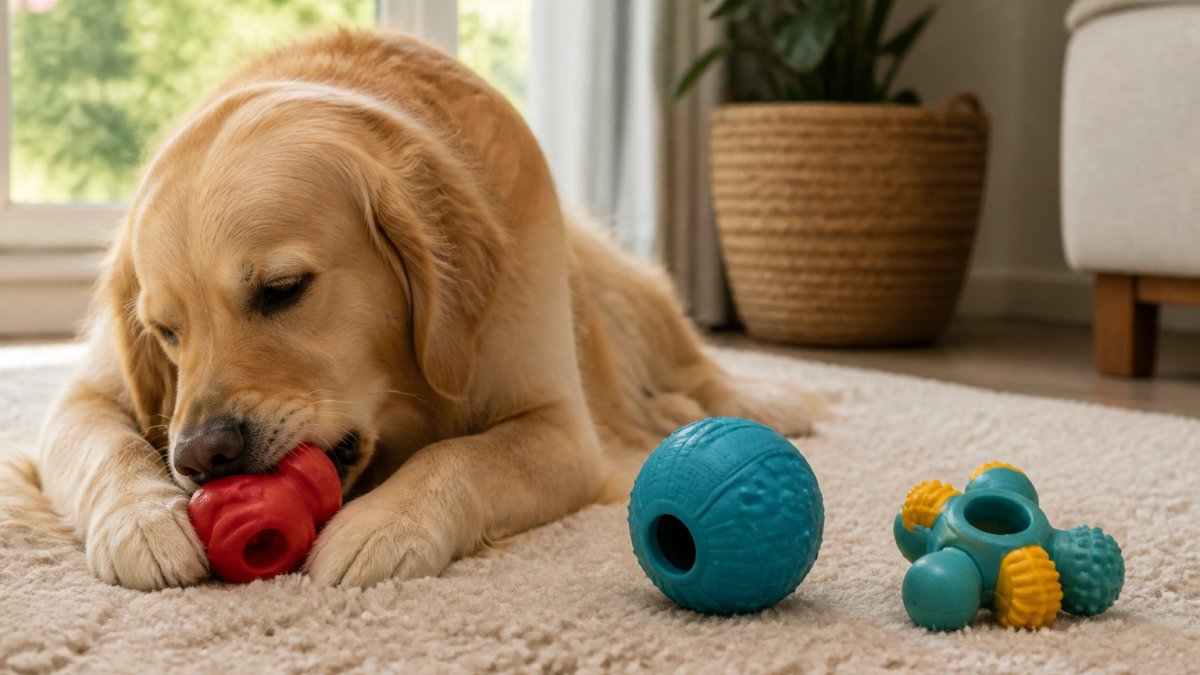
Quick Picks:
- Best Overall: KONG Classic, stuffable, freezable, endlessly reusable
- Best for Separation Anxiety: Snuggle Puppy, heartbeat and warmth mimic a littermate
- Best for Boredom: Nina Ottosson Puzzle, problem-solving that tires a dog out
- Best for Power Chewers: West Paw Zogwlex Qwizl, tough enough to survive
- Best for Natural Calming: Forager Snuffle Mat, sniffing lowers arousal
| Toy | Best For | Key Feature | Price |
|---|---|---|---|
| KONG Classic | Crate training, anxiety | Freezable hollow center | $12.00 |
| Snuggle Puppy | Separation anxiety | Pulsing heartbeat | $39.95 |
| Nina Ottosson Puzzle | Boredom busting | Multi-level difficulty | $14.99 |
| West Paw Qwizl | Aggressive chewers | Recyclable Zogoflex | $21.95 |
| Forager Snuffle Mat | Scent work, slow feeding | Machine washable | $16.99 |
KONG Classic Dog Toy: The Gold Standard for Stuffable Calming
The KONG Classic is the toy most trainers reach for first. Its hollow natural rubber center holds treats, peanut butter, or frozen kibble, turning a simple chew into a long, calming project.
Snuggle Puppy Behavioral Aid Toy: Heartbeat Comfort for Separation Anxiety
Snuggle Puppy targets a different problem: a plush companion with a battery-operated heartbeat and warmth pack that mimics a littermate's presence.
Nina Ottosson by Outward Hound Puzzle Toy: Mental Gymnastics for Boredom Busting
Boredom is the root of a lot of bad behavior, and a puzzle toy attacks it directly. Some puzzle toys challenge dogs to slide, flip, and paw at compartments for hidden treats.
West Paw Zogoflex Qwizl: Best Durable Toys for Aggressive Chewers
If you've watched a "tough" toy die in twenty minutes, some durable toys are built from flexible but chew-resistant material that holds long-lasting treats like bully sticks.
Forager Snuffle Mat: Scent Work for Natural Calming
Sniffing is the most underrated calming tool in dog ownership. A snuffle mat hides dry food or treats in felt strips, forcing your dog to work its nose to eat.
Pro Tip
Freeze a stuffed KONG and pair it with a snuffle mat session. The nose work lowers arousal first, then the frozen chew holds the calm. Trainers call this stacking, and it works better than either toy alone.
How to Choose Safe Enrichment Toys for Dogs
Choosing safe enrichment toys for dogs comes down to four checks: material chemistry, size and shape, chew strength, and supervision level. Get those right and you avoid most injuries, wasted money, and the quieter problem of a toy that's intact but leaching things you don't want in a dog's mouth.
Material: read past the word "durable"
Durability tells you how long a toy survives, not what the dog ingests while chewing.
- Natural rubber flexes and rebounds rather than shattering into shards, spreading bite force instead of concentrating it at one crack point.
- Food-safe, BPA-free plastic is a common material for puzzle toys. "BPA-free" is a marketing claim, not a regulated certification, so treat it as a starting point, not a guarantee.
- Thermoplastic elastomers are recyclable at end of life, a real advantage for heavy chewers, since the toy is reclaimed rather than abraded into the carpet.
- Plush and fabric toys are the hardest category to vet. Stuffing, squeakers, and glued-on eyes are the parts that end up in a dog's stomach, not the outer fabric.
Size and shape: weight range, not breed
A toy that's too small is a choking hazard; too large and your dog loses interest. Match the toy to your dog's weight range, not its breed, a 20-pound terrier and a 20-pound spaniel have different jaw mechanics but the same swallowing risk.
Chew strength: match the dog, not the label
Manufacturers grade chew strength in tiers, but the tiers are self-reported. A plush toy handed to a power chewer is a five-minute mistake; a rock-hard chew given to a soft-mouthed senior can crack a tooth, far more expensive than a destroyed plush.
Supervision: the tier that actually prevents vet visits
- Puzzle toys and plush aids need eyes on them. Pieces can be swallowed once a dog gets frustrated, and frustration is exactly when chewing intensity spikes.
- Durable rubber can generally go solo, but only after you've watched the dog use it a few times and confirmed it isn't working a seam.
- Rope and fabric toys should be retired the moment strands start separating. Ingested string is a linear foreign body, one of the more serious things a dog can swallow.
Rotation and end-of-life
Keep three or four toys in rotation so novelty stays high, a toy that lives on the floor permanently becomes furniture. Recyclable materials can also keep worn-out chews out of landfills. Inspect every toy weekly for cracks, missing pieces, and softening rubber, and retire anything that fails the thumbnail test.
Watch Out
Never leave a dog alone with a puzzle toy or plush aid. Pieces can be swallowed once a dog gets frustrated, and that's a vet visit you can prevent by staying in the room.
Key Takeaway
Material chemistry, size-to-weight match, chew-strength fit, and supervision tier are the four checks that matter. "Durable" answers only one of them.
How Long Should a Dog Play with Enrichment Toys?
A typical enrichment session should run 10 to 20 minutes, once or twice a day, enough mental stimulation without overstimulating an anxious dog. But the mechanism behind it matters more than the number.
Why the window exists
Licking, chewing, and sniffing are repetitive, rhythmic behaviors, and repetition drives the calming effect, the same way a pacifier works for an infant. The behavior itself is the regulation, not the treat at the end.
Using enrichment inside a training protocol
Most buying guides skip this: calming toys aren't just something to hand a dog while you leave, they can be built into a desensitization and counter-conditioning plan for separation anxiety.
The sequence most trainers use:
- Establish the toy as a positive. Before any departure practice, let the dog use the frozen KONG or snuffle mat while you're home and relaxed. The toy needs to already mean "calm" before it can mean "you're leaving."
- Pair the toy with the trigger at low intensity. Pick up your keys, then hand the toy. Open the door, then hand the toy. The toy arrives with the thing that used to predict panic.
- Extend duration gradually. Step outside for ten seconds, come back, remove the toy. Build to a minute, then five. The toy is present during the absence as the conditioned calm response.
- Fade the setup. Once the dog settles reliably, the toy can be offered before departure without the rehearsal steps.
Enrichment for senior dogs with cognitive decline
Most content targets puppies or "anxious dogs" generally. Geriatric cognitive decline, the canine equivalent of age-related cognitive changes, is underserved, and the guidance is genuinely different.
What changes for seniors specifically:
- Scent work over puzzle work. Sniffing is a lower-frustration task than manipulating latches and sliders. A snuffle mat lets a senior dog succeed without the fine motor demands a puzzle requires.
- Lower physical demand. Skip toys that require pawing, flipping, or sustained standing. A lick mat or a stuffed toy the dog can work while lying down is a better fit.
- Consistency over novelty. The rotation advice that keeps a young dog engaged can confuse a dog with cognitive decline. Keep the same two or three toys in the same spots.
- Watch for regression. A dog that suddenly can't solve a puzzle it used to solve isn't being stubborn. That's a change worth mentioning to a veterinarian.
Sensory-specific enrichment
Food-based toys dominate this category, but not every dog is food-motivated, and some have sensory sensitivities that make certain textures or sounds aversive rather than calming.
- Auditory: Some dogs settle to consistent low sound, a fan, a white-noise machine, a ticking clock. Others are startled by squeakers. If your dog flinches at a squeak, that toy is working against you.
- Tactile: Texture matters. A dog that avoids slick plastic may settle instantly on a plush or fleece-covered mat. A dog that shreds plush may need the opposite, a firm, cool rubber surface.
- Olfactory: Scent is the most reliable calming channel across most dogs. A snuffle mat, a scatter feed in the yard, or a few treats hidden in a folded towel all work the same olfactory system without requiring a purchase.
Key Takeaway
Session length is a proxy for a simpler rule: stop while the dog is still succeeding. For seniors, go shorter and more frequent. For anxious dogs, the toy has to be conditioned before the trigger, not handed over during it.
Frequently Asked Questions
What are the best enrichment toys for anxious dogs?
Calming enrichment toys for anxious dogs can include stuffable rubber toys, heartbeat comfort toys, and snuffle mats that encourage natural foraging. These toys promote mental stimulation and activate the parasympathetic nervous system, helping reduce stress and separation anxiety. For durable options, some toys are designed for aggressive chewers.
How do enrichment toys help calm a pet?
Enrichment toys calm pets by redirecting nervous energy into productive activities like licking, chewing, or sniffing. These actions trigger the release of endorphins and activate the parasympathetic nervous system, which lowers heart rate and promotes relaxation. Puzzle feeders and snuffle mats also mimic natural foraging behavior, reducing boredom and destructive chewing while providing a sense of accomplishment.
Are puzzle toys effective for reducing separation anxiety?
Yes, puzzle toys can significantly reduce separation anxiety by keeping dogs mentally engaged when alone. Some puzzle toys require problem-solving, which shifts focus away from anxiety triggers. For best results, pair puzzle toys with a consistent routine and gradually increase alone time. Always supervise initially to ensure your dog doesn't become frustrated or destructive.
How long should a dog play with enrichment toys?
Most dogs benefit from 15-30 minutes of focused enrichment play per session, 1-2 times daily. High-energy breeds may need longer, while seniors or flat-faced breeds tire faster. Rotate toys every few days to prevent boredom and always supervise to prevent overexertion. If your dog loses interest or becomes frustrated, end the session and try a different type of toy.
What should I look for in a durable enrichment toy?
Look for toys made from natural rubber, BPA-free materials, or puncture-resistant nylon. Check for a solid construction without small parts that can break off. For aggressive chewers, choose toys rated for power chewers. Always match the toy size to your dog's breed and chewing style, and replace any toy showing cracks or wear.
A bored or anxious dog will find its own entertainment, and you won't like what it picks. Paws ND Whiskers stocks engaging toys, cozy beds, and grooming tools designed to keep pets comfortable and calm, all chosen to strengthen the bond between you and your dog. Our curated selection focuses on quality and reliability, so you're not replacing a shredded toy every week. Add to Cart and give your dog something worth chewing on.

